Glasskube Review: The Kubernetes Package Manager That Died Before 1.0
Sources
- Glasskube GitHub repository (archived)
- Glasskube company homepage — deprecation notice
- Glasskube v0.26.1 release (final)
- Glasskube packages repository (archived)
- Glasskube Apps Operator (the surviving component)
- Distr — the company's pivot product
- Show HN thread (June 2024, 266 points)
- Flux Helm controller documentation
Some tools die loudly — a farewell blog post, an archived-repo banner, a migration guide. Glasskube died the other way. The repositories went archived in June 2026, the company homepage now describes the product as "previously created … (now deprecated)," and the founder energy moved to Distr, a self-hosted software distribution platform. But the install docs are still live — last updated September 18, 2026 by a bot, with no deprecation warning — and the central package repository still serves requests. If you arrive from the HN thread or a "Kubernetes package manager" search, nothing on the docs path tells you the thing you are about to install has been abandoned.
We took the ranker's dispatch at face value last week ("gaining viral traction, HN trending") and nearly wrote this up as a hot new tool. It isn't new and it isn't trending: the Show HN thread it pointed at is from June 2024. The actual story — verified against the GitHub API, the live package index HTTP headers, the binary itself, and the company's own site — is a deprecation forensics file. Every claim below is sourced from the repo state at the time of writing.
Executive Scorecard
| Dimension | Score | Verdict |
|---|---|---|
| Reliability | 1/10 | Core repos archived June 2026; last release January 2025; no patch path for the operator or the CLI you already run. |
| DX | 5/10 | The CLI is pleasant and the GUI genuinely nice; but the version metadata it serves is stale, and nothing tells you why. |
| Cost | 2/10 | Apache-2.0 and free — until you realize the migration cost to leave is the entire price of the tool. The real cost is the exit. |
| Security | 2/10 | A control plane that binds cluster-admin twice and pins Flux controllers at 2023-era versions, forever. |
What Glasskube Actually Was
Glasskube set out to be "apt for Kubernetes": a package manager with a central public repository, a CLI, a web UI, dependency-aware packages, and automatic updates. You can still read the pitch in the archived repository README. The design was real and shipped: CRDs, an operator, a package repository abstraction, value injection from ConfigMaps and Secrets, and a GitOps mode driven by the same CRs.
Under the hood it was never a from-scratch packager. The operator reconciles two custom resources — Package (namespaced) and ClusterPackage (cluster-scoped) — into either pinned upstream manifests or HelmRelease/HelmRepository objects owned by Flux controllers. The aio bootstrap manifest we inspected ships Flux's helm-controller and source-controller pinned at v1.0.1 and v1.3.0 respectively, plus the Glasskube package-operator itself. So the "Helm alternative" installs Helm-plus-Flux and adds a metadata layer on top — a fair description of what a Kubernetes package manager can be, but also the source of every operational edge this review found.
# from glasskube v0.26.1 manifest-aio.yaml (48 objects, 10 CRDs)
kind: Deployment
metadata:
  labels:
    app.kubernetes.io/component: helm-controller
    app.kubernetes.io/instance: glasskube
---
kind: Deployment
metadata:
  labels:
    app.kubernetes.io/component: source-controller
    app.kubernetes.io/instance: glasskube
---
kind: Deployment
metadata:
  name: glasskube-controller-manager
  namespace: glasskube-system
That is the whole trick, and it is a reasonable one: packages become declarative CRs that any GitOps engine can render. A ClusterPackage for Argo CD is a small object, and a Flux user recognizes the shape immediately:
apiVersion: packages.glasskube.dev/v1alpha1
kind: ClusterPackage
metadata:
  name: argo-cd
spec:
  packageInfo:
    name: argo-cd
    version: v2.14.1+1
  values:
    server:
      ingress:
        enabled: true
The +1 suffix is Glasskube's package revision appended to the upstream version — you need their package index to resolve it, which becomes the single point of failure this review returns to.
Architecture Mechanics
Stripped of marketing, Glasskube is a CRD-and-operator layer that resolves package metadata over HTTP and delegates the actual work to pinned upstream manifests or Flux. The flow for installing a package without an explicit version pin:
  glasskube install argo-cd
        |
        v
  [1] fetch repo index.yaml          (GET packages.dl.glasskube.dev/packages/index.yaml)
        |                              headers show Last-Modified: Dec 14 2025
        v
  [2] fetch package versions.yaml     (latestVersion: v2.14.1+1  <-- stale field)
        |
        v
  [3] resolve manifest package.yaml   (pinned raw manifest URL or helm chart ref)
        |          |
        |          +-- helm packages --> HelmRelease (flux helm-controller v1.0.1)
        |                                        + HelmRepository (flux source-controller v1.3.0)
        v
  [4] create Package/ClusterPackage CR in glasskube-system
        |
        v
  [5] glasskube package-operator reconciles CR --> applies manifests/helm release
        |
        v
  [6] status: version, conditions, owned resources
Steps 1–3 happen over plain HTTPS GETs against the central repository — index.yaml, then <name>/versions.yaml, then <name>/<version>/package.yaml (verified in internal/repo/client/defaultclient.go). There is no signature verification on the package metadata path: the client parses whatever YAML the repository serves. That was defensible when the repository was actively curated; with the repo frozen and the project dead, it is an unattended supply-chain dependency you cannot patch, because there is no one left to patch it.
The reconciliation loop (step 5) is a standard controller-runtime reconcile: watch Package and PackageInfo CRs, fetch the manifest, validate value definitions against the manifest's schema, resolve dependencies via the dependency manager, then create either raw manifests (fetched from the URL baked into the wrapper — e.g. a raw.githubusercontent.com install.yaml for Argo CD) or Flux objects. The CRD conversion webhook runs behind a cert managed by a CronJob and an init Job in glasskube-system. The bootstrap also installs a daily glasskube-autoupdate CronJob that runs the CLI against the cluster to bump packages with the auto-update annotation:
# config/autoupdater/cronjob.yaml, v0.26.1
apiVersion: batch/v1
kind: CronJob
metadata:
  name: glasskube-autoupdate
spec:
  schedule: "0 0 * * *"
  concurrencyPolicy: Replace
  jobTemplate:
    spec:
      template:
        spec:
          securityContext:
            runAsNonRoot: true
          containers:
            - name: glasskube
              image: ghcr.io/glasskube/glasskube
              args:
                - auto-update
                - --skip-update-check
          serviceAccountName: glasskube-autoupdate
          restartPolicy: OnFailure
State management is honest: package state lives in the CRs and cluster, and the package-operator keeps the gap between spec and status visible. Suspend/resume annotations pause reconciliation. The design held up technically. What killed it is visible only when you look at the network layer — which is where we go next.
The Frozen Index: Verified Failure Modes
This is the part that matters operationally, so every number below was fetched live from the central repository during this review, not from a blog post. The repository root still serves an index of 31 packages. The HTTP response headers report Last-Modified: Sun, 14 Dec 2025 02:35:31 GMT — nine months frozen at the time of writing. The packages repository GitHub mirror shows the same freeze: its last package update commit landed November 2025, its last commit of any kind January 2026.
The freeze produces a failure mode worse than "no new packages": the version metadata is internally inconsistent. The per-package versions.yaml keeps an explicit latestVersion: field that automation stopped updating earlier than the version list itself:
# packages.dl.glasskube.dev/packages/argo-cd/versions.yaml (fetched 2026-09-22)
latestVersion: v2.14.1+1     # <-- what `glasskube install argo-cd` resolves
versions:
  - version: v2.10.2+1
  # ... 50 more versions, appended by automation until Nov 2025 ...
  - version: v3.0.0+1
  - version: v3.1.0+1
  - version: v3.2.0+1       # <-- present in the list, NEVER promoted to latest
The CLI's default resolution path reads latestVersion and stops there (verified in cmd/glasskube/cmd/install.go: when no version is specified, installCmdOptions.Version = packageIndex.LatestVersion). So a fresh glasskube install argo-cd today pins Argo CD 2.14.1 — a major version behind what the same file already contains, and behind the Argo CD 3.x line the rest of the ecosystem runs. We checked whether this is a one-off. It is systemic:
| Package (live index) | latestVersion serves | Same file's list contains | Upstream reality (Sep 2026) |
|---|---|---|---|
| argo-cd | v2.14.1+1 | v3.2.0+1 | v3.5.3 stable |
| kube-prometheus-stack | v68.4.4+1 | v79.5.0+1 | chart 79.x |
| ingress-nginx | v1.12.1+1 | v1.14.0+1 | helm-chart-4.15.1 |
| cert-manager | v1.17.0+2 | v1.19.1+1 | v1.20.4 |
| metrics-server | v0.7.2+1 | v0.8.0+1 | v0.9.0 |
And that is the good case. The auto-updater's comparison loop (pkg/update/update.go) walks the index's LatestVersion per package and skips anything that does not satisfy semver.IsUpgradable — meaning a cluster that trusts auto-updates will sit on these frozen versions forever, silently. No error, no alert, just a nightly CronJob that correctly concludes there is nothing to do. The tool's headline feature — safe automatic updates — is the exact mechanism by which it now fails: it works as designed, and the design reads a dead file.
Contrast that with the binary's own behavior, which we verified hands-on. We downloaded the real v0.26.1 Linux x86-64 tarball (SHA-256 verified against the release checksums file: 403d8040…66e921), ran it against a dead kubeconfig, and observed the actual outputs:
$ ./glasskube list --kubeconfig /tmp/dead-kubeconfig
Error validating Glasskube:

Get "https://127.0.0.1:9/apis/apiextensions.k8s.io/v1/customresourcedefinitions/packages.packages.glasskube.dev":
dial tcp 127.0.0.1:9: connect: connection refused

$ echo $?
1
Exit code 1, a clean error naming the missing CRD — good CLI hygiene. The version check phoning GitHub for a newer release is opt-out via --skip-update-check; it will never find one now, which is its own quiet eulogy. The telemetry subsystem (PostHog-backed, machine-ID keyed, recording command/args/exit-code per invocation) is enabled by default at bootstrap unless --disable-telemetry is passed — worth knowing for the clusters where it is still running: those events are still being collected by a company whose featured product is now something else entirely.
The Timeline of the Collapse
Pin down the dates and the pattern is a textbook VC-funded OSS arc: fast launch, HN fame, big-company praise, then a pivot before 1.0. The GitHub API gives exact timestamps:
| Date | Event (verified source) |
|---|---|
| 2024-01-11 | Repository created. Show HN "technical preview" February 2024 (29 points). |
| 2024-06-25 | Show HN front page, 266 points, 118 comments — peak mindshare. "20x faster than Helm" claim born. |
| 2024-09→2025-01 | Rapid releases: v0.19 → v0.26.1 (Jan 7, 2025). Then the cadence stops. |
| 2025-01-14 | Release-please opens PR #1486 "chore(main): release 0.27.0". It is still open, never merged — the freeze point, visible in the repo. |
| 2025-01-29 | Distr announced on Show HN (117 points). The pivot begins. |
| 2025-05-20 | Last code commit to the main repository — a dependency bump. Nothing but bot PRs after. |
| 2025-11-05 | Last package update in the packages repository (argo-cd to v3.2.0+1 — appended to the list, never promoted). |
| 2026-06-14/17 | Main repo and packages repo archived=true on GitHub. The end, unannounced on the docs site. |
| 2026-09-18 | Install docs still updated by renovate[bot] — automated, unattended, no deprecation banner. |
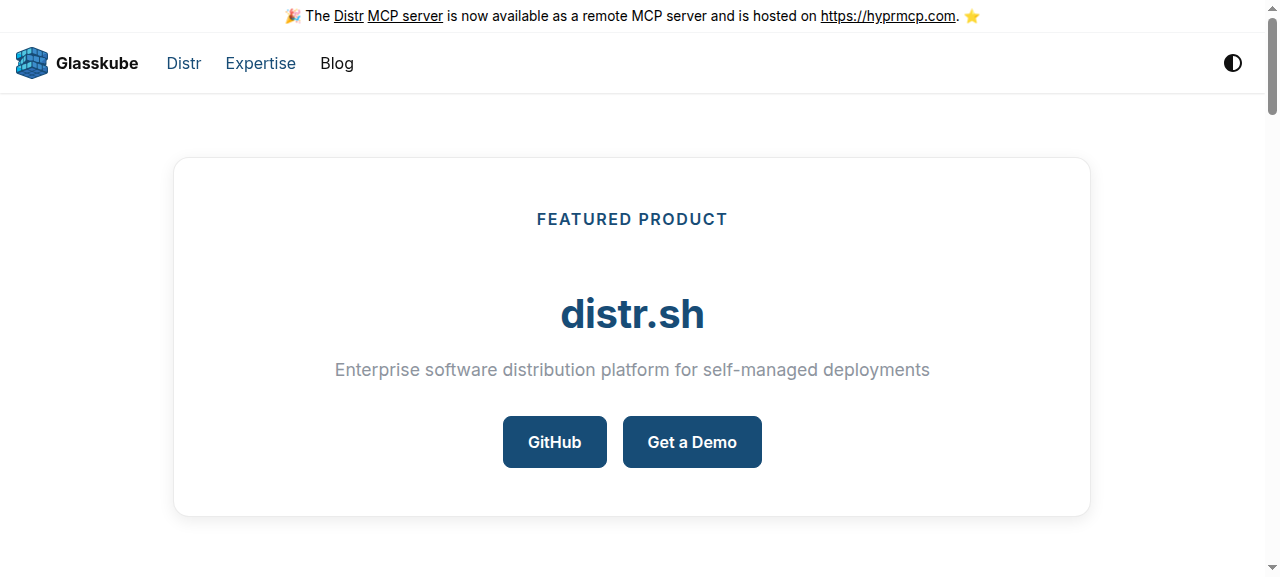
The company homepage completes the arc: "Previously created a Kubernetes package manager and operator (now deprecated)." The founder team now runs Distr — an enterprise software distribution platform for self-managed deployments, itself open source (Apache-2.0) and actively developed (1,226 stars, daily commits). Distr is arguably the same insight — packaging and distributing software — pointed at a market that pays. If you liked Glasskube's ideas, watch Distr instead; the operator's package concepts live on there.
One component of the old ecosystem survives: the Glasskube Apps Operator (glasskube.eu, not glasskube.dev) — the company's pre-package-manager product for operating individual apps like Odoo — is unarchived and still receives releases (0.14.2, September 17, 2026). It is a different product line; do not confuse its activity for package-manager maintenance.
Security Postmortem: cluster-admin, Forever
Two findings deserve their own section because they outlive the product. First, the bootstrap manifests bind cluster-admin to the controller ServiceAccounts — not just for the embedded Flux controllers (the cluster-reconciler binding, which Flux users will recognize) but for the Glasskube package-operator itself:
# manifest-aio.yaml, v0.26.1
apiVersion: rbac.authorization.k8s.io/v1
kind: ClusterRoleBinding
metadata:
  name: cluster-reconciler
roleRef:
  kind: ClusterRole
  name: cluster-admin
subjects:
- kind: ServiceAccount
  name: kustomize-controller
  namespace: flux-system
- kind: ServiceAccount
  name: helm-controller
  namespace: flux-system
---
apiVersion: rbac.authorization.k8s.io/v1
kind: ClusterRoleBinding
metadata:
  name: glasskube-manager-rolebinding
roleRef:
  kind: ClusterRole
  name: cluster-admin
subjects:
- kind: ServiceAccount
  name: glasskube-controller-manager
  namespace: glasskube-system
A package manager whose entire value proposition is "apply arbitrary upstream manifests with one command" is a privileged piece of software by definition; running its operator as cluster-admin was a defensible v0 choice and a poor permanent one. The kubebuilder-generated granular RBAC rules exist in the same manifest (the controller needs verb-scoped access to its CRDs, HelmReleases, HelmRepositories, namespaces, and events — we verified the package_controller.go RBAC markers), so the cluster-admin binding is a shortcut layered on top of a working least-privilege set. Now that the project is dead, that shortcut is permanent: no release will ever tighten it. Any cluster still running the operator carries an unpatchable, internet-reachable-if-exposed, cluster-admin-equivalent workload.
Second, the pinned Flux controllers. helm-controller v1.0.1 and source-controller v1.3.0 are 2023-era releases; current stable releases are helm-controller v1.6.4 (August 2026) and source-controller v1.9.5. Flux ships CVE fixes in these lines — the helm-controller changelog is a running list of exactly the kind of fixes you do not want unpatched in a cluster. Glasskube pinned them in its bootstrap manifest and stopped shipping. The upgrade path is: delete Glasskube, or manually manage Flux objects it created (its CRs and the Flux controllers are separate concerns — removing the operator does not remove the Flux controllers, and vice versa).
Migration: How to Leave Gracefully
If Glasskube is installed on a cluster you operate, the exit is cleanable because the design was declarative. Every package is a CR; every CR has an ownerReference trail; the operator applies either pinned upstream manifests or Flux HelmRelease objects. The exit plan, in order:
# 1. Inventory: every Glasskube-managed package on the cluster
kubectl get clusterpackages.packages.glasskube.dev -A
kubectl get packages.packages.glasskube.dev -A

# 2. Note what each package actually is under the wrapper:
#    - helm-based: kubectl get helmreleases.helm.toolkit.fluxcd.io -A
#      (the Glasskube operator created these; Flux reconciles them)
#    - manifest-based: the package.yaml wrapper pins a raw URL,
#      e.g. raw.githubusercontent.com/argoproj/argo-cd/v2.14.1/manifests/install.yaml

# 3. For each package, adopt the underlying upstream install into
#    your GitOps flow (helm release or raw manifest), THEN delete
#    the Glasskube CR. Never delete the CR first.

# 4. Remove the control plane (bootstrap in reverse):
kubectl delete -f https://github.com/glasskube/glasskube/releases/download/v0.26.1/manifest-aio.yaml

# 5. Remove the auto-updater CronJob if present (it re-runs nightly):
kubectl delete cronjob glasskube-autoupdate -n glasskube-system
Two subtleties bite during migration. First, the Flux controllers shipped by the aio bootstrap are separate Deployments; deleting the Glasskube operator leaves them running (check flux-system), so decide deliberately whether to keep them (and upgrade them to current Flux releases) or remove them after migrating their objects. Second, if any package was installed at the stale latestVersion, your "current version" state is a lie relative to upstream — Argo CD 2.14.1 is not merely old, it is a major behind. Treat the migration as an upgrade, budget test time for it, and pull the version numbers from upstream, not from Glasskube's index.
For teams that never installed it: the alternatives are healthier and the choice depends on what you actually wanted from Glasskube. If you wanted declarative packages, Flux's HelmRelease (or plain Argo CD apps) is what Glasskube wrapped anyway — we have a full comparison. If you wanted typed values and better packaging UX, Timoni (2,016 stars, active as of September 2026) is the closest living project in spirit — CUE-based, modular, no Helm templating. If you wanted a GUI over Helm, that problem is better solved by a dashboard in front of your existing GitOps engine than by a new package abstraction. The Carvel kapp-controller line (active, September 2026) covers the packaging-and-applying niche with a longer track record.
Critical Failure Modes (Summary)
| Failure mode | Trigger | What you see |
|---|---|---|
| Silent version rot | Any install/auto-update after Dec 2025 | Packages pinned at stale latestVersion; auto-updater no-ops nightly; no errors anywhere. |
| Internally inconsistent index | versions.yaml list vs latestVersion field | Newer wrapper exists in the list but is never promoted; default installs pin majors behind. |
| No unpatch path | CVEs in operator, CLI, or pinned Flux controllers | Repos archived; last release Jan 2025; cluster-admin bindings permanent. |
| Docs still onboarding | New users arriving via search/HN | Install page live and bot-updated Sep 2026; no deprecation warning on any docs page. |
| Unattended supply chain | Package metadata fetched over unsigned HTTP(S) | Client trusts whatever the (now-unmaintained) central repo serves; no signature verification. |
| Telemetry by default | Bootstrap without --disable-telemetry | PostHog events (command, args, exit code) keyed by machine ID; still collected post-mortem. |
Verdict: Who Should Skip This — Everyone, Now
New adopters: do not install it. Not because the code was bad — the CLI was pleasant, the CRD design was sound, the GUI was genuinely the nicest in its niche — but because the adoption math has collapsed: you would be adopting a control plane whose only update path is a frozen file, whose operator runs as cluster-admin with no patch future, and whose company has moved on. Every hour of integration work is sunk cost against a migration you will have to do anyway.
Existing operators: schedule the exit this quarter. The system keeps working until an upstream CVE forces your hand; the migration is declarative and bounded, and doing it before an incident beats doing it during one. Budget a day per cluster for the inventory, adoption of underlying Helm releases/manifests into your GitOps flow, and teardown of the operator plus its cluster-admin bindings and pinned Flux controllers.
The broader lesson is the uncomfortable one. Glasskube's real product was never the CLI — it was the centralized package index, the thing that made "one command" possible, and the thing whose maintenance is the least glamorous work in software. When the funding pivoted, the index froze before the code did, and the failure surfaced first in the exact place the value lived. A Kubernetes package manager without a funded, governed, actively-curated index is not a package manager; it is a CRD wrapper around other people's charts. That is the question to ask any successor project — including Distr, which deserves watching precisely because its founders already know this failure mode intimately.
References & Further Reading
- Glasskube main repository (archived June 2026) — README, v0.26.1 release, aio bootstrap manifests.
- Glasskube company homepage — "previously created a Kubernetes package manager and operator (now deprecated)."
- Glasskube packages repository (archived) — the 31-package central index, frozen.
- The live package index — Last-Modified Dec 14, 2025; internally inconsistent version metadata.
- Glasskube Apps Operator — the surviving, separate product line (glasskube.eu).
- Distr (distr-sh/distr) — the pivot product, actively developed.
- Show HN: Glasskube (June 2024) — 266-point launch thread with the community's early structural critiques.
- Flux helm-controller — the reconciliation engine Glasskube wrapped; note the version gap (v1.0.1 pinned vs v1.6.4 current).
- Timoni — the closest living alternative for typed, modular Kubernetes packaging.
- Carvel kapp-controller — the packaging-and-applying alternative with a longer track record.